Key points
- The National Pension lump-sum refund gives your contributions back when you leave Korea. You qualify if your status of stay was E-8 (employment for training), E-9 or H-2, or if your country is on the official list.
- The money is everything paid into your account, including your employer’s share, plus interest.
- Seasonal workers on E-8 cannot get this refund, even though the visa code looks the same.
- Claim it within 5 years. You can apply up to one month before you fly, but payment needs a confirmed departure.
- It is a different payment from the severance insurance your employer pays for. Each has its own claim.
Can you get your pension money back when you leave Korea?
Often, yes. Foreign residents aged 18 to under 60 generally must join the National Pension (국민연금, gungmin yeongeum), just like Korean citizens. Some groups are excluded, such as students and diplomats. At work, you and your employer each pay a share.
When you leave Korea for good, this money can come back to you as a lump-sum refund (반환일시금, banhwan ilsigeum). The National Pension Service (NPS, 국민연금공단) pays it. Not every foreign worker qualifies, though.
The National Pension Act gives three routes to the refund. You need only one of them:
- Your status of stay (체류자격, cheryu jagyeok) when you paid in was E-8 (employment for training), E-9 (non-professional employment) or H-2 (visiting employment).
- Your country has a social security agreement (사회보장협정, sahoe bojang hyeopjeong) with Korea that covers this refund.
- Your country pays Korean citizens a similar refund. NPS calls this reciprocity (상호주의, sangho juui).
The sections below check each route in order. Start with your visa, because it is the fastest check.
Step 1: Does your status of stay qualify?
If you paid in while holding E-9 or H-2, your nationality does not matter. The same is true for E-8 when it means employment for training. These workers have been able to get the refund since May 11, 2007.
There is one trap. A newer E-8 status for seasonal work was created on December 24, 2019. NPS says in its Korean guidance that this seasonal E-8 status does not get the refund.
The English NPS page does not mention this exception. An older English NPS visa list even labels E-8 as “Seasonal Worker.” This article follows the Korean original, because it is the official text.
| Your status of stay while you paid in | Refund through your visa? |
|---|---|
| E-9 (non-professional employment) | Yes, any nationality |
| H-2 (visiting employment) | Yes, any nationality |
| E-8 (employment for training) | Yes, any nationality |
| E-8 seasonal work (created December 24, 2019) | No. Check Step 2 instead |
| Any other status (for example E-7, F-2, F-6) | Not through your visa. Check Step 2 |
The law itself does not list visa codes. It names workers hired under the Employment Permit System (고용허가제, goyong heoga je), known as EPS. It also names certain industrial trainees. NPS links these groups to E-8, E-9 and H-2 in its guidance.
Step 2: Is your country on the list?
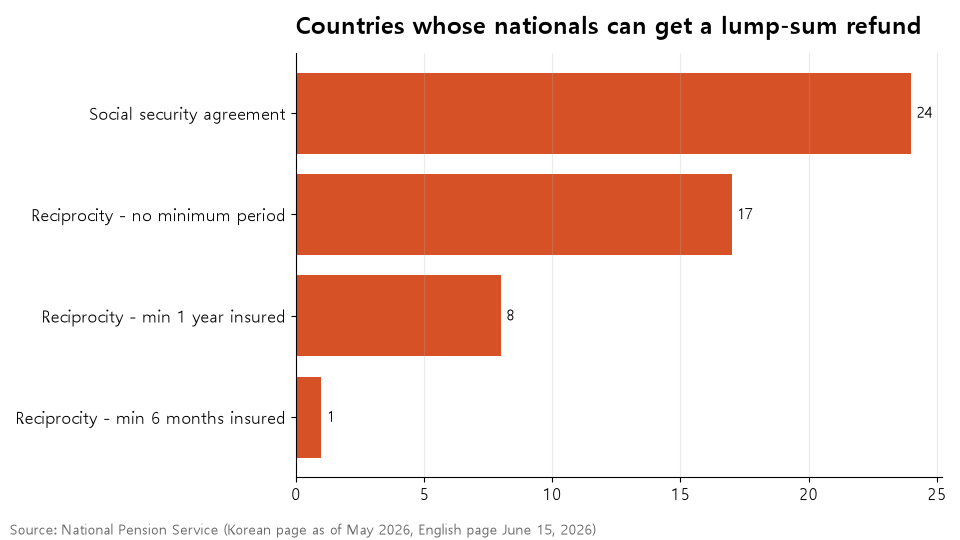
If Step 1 did not work, your nationality decides. NPS publishes a list of 50 countries. The Korean page is dated May 2026, and the English page is dated June 15, 2026. Both show the same countries.
| Group | Countries |
|---|---|
| Social security agreement (24 countries) | Germany, the United States, Canada (including Quebec), the Czech Republic, Hungary, Australia, France, Belgium, Bulgaria, Poland, Slovakia, Romania, Austria, India, Türkiye, Switzerland, Brazil, Peru, Luxembourg, Slovenia, Croatia, Uruguay, the Philippines, Argentina |
| Reciprocity, any insured period (17 countries) | Ghana, Sri Lanka, Bermuda, Malaysia, El Salvador, Indonesia, Kenya, Kazakhstan, Hong Kong, Trinidad and Tobago, Sudan, Colombia, Vanuatu, Tunisia, Uganda, Cambodia, the Solomon Islands |
| Reciprocity, at least 1 year insured (8 countries) | Grenada, Jordan, Saint Vincent and the Grenadines, Zimbabwe, Cameroon, Thailand, Bhutan, Laos |
| Reciprocity, at least 6 months insured (1 country) | Belize |
For India, NPS shows the date November 1, 2011. For Türkiye and Switzerland, it shows June 1, 2015. Lists like this can change, so check the NPS page before you plan around it.
If neither Step 1 nor Step 2 fits you, the lump-sum refund on leaving Korea is not available. A Korean pension may still be possible later if you meet the pension rules, but that is a separate topic.
How much money comes back?
The refund has two parts. The first part is all the pension contributions paid for you. For workplace members, this includes the employer’s share, not only the part taken from your pay.
The second part is interest. NPS uses the average 3-year fixed deposit rate of nationwide banks on January 1 of each year. For 2026, that rate is 2.2%.
Interest runs from the month after each payment. It stops in the month you become entitled, for example the month you leave Korea. Contributions paid before April 16, 2015 use the 3-year deposit rate from April 2015.
The final amount comes from NPS, so ask them for your figure. Call 1355 in Korea or +82-63-713-6900 from abroad (weekdays, 9:00 a.m. KST to 6:00 p.m. KST, fees apply).
Is this the same as your departure severance insurance?
No. EPS workers often mix up two payments. The second one is the departure severance insurance (출국만기보험, chulguk mangi boheom). Employers of EPS workers must pay into it every month instead of a normal severance plan.
| Lump-sum refund (National Pension) | Departure severance insurance | |
|---|---|---|
| What it is | Your pension contributions returned with interest | A severance payment for foreign workers |
| Who paid in | You and your employer | Your employer only (8.3% of monthly ordinary wages) |
| Who pays you | NPS | The insurer named by EPS (Samsung Fire & Marine) |
| How you apply | NPS office, airport service, mail or an agent | Departure report at a job center, then a claim to the insurer |
| Short stays | NPS lists no minimum period for E-8, E-9 and H-2 | Under 1 year at the same workplace, the money goes to the employer |
| Payment time | After your departure is confirmed | Within 14 days after you leave |
| Deadline | 5 years | 3 years |
For the severance insurance, you file a departure report at a job center. You can do this from one month before your planned departure date. The center gives you a confirmation, and you send it with your claim to the insurer.
If the insurance amount is lower than the legal severance pay, the employer must pay the difference. There is also a separate return cost insurance that you pay for yourself. That is a third payment, not part of the pension.
How do you apply before you leave Korea?
Visit any NPS branch office in Korea. You must apply yourself, in person. Phone and fax claims are not accepted for foreign nationals.
Bring these documents:
- The lump-sum refund claim form
- Your passport
- Your residence card (formerly Alien Registration Card, 외국인등록증, oegugin deungnokjeung)
- A copy of your bank account proof
- Proof that you will leave within one month, such as your flight ticket
NPS can accept the claim up to one month before departure. Since August 29, 2007, it pays only after your departure is confirmed.
Getting cash at Incheon Airport
NPS offers cash on your departure day at Incheon International Airport. You get foreign currency in one of 16 currencies, but not Korean won.
These conditions apply:
- You leave from Incheon Airport within one month of your claim.
- Your employer reports your loss of coverage to NPS by the day before you fly.
- Your flight is on a weekday, but not a public holiday or the last business day of December.
- Your flight leaves between 10:30 a.m. KST and midnight from Terminal 1. From Terminal 2, it leaves between 11:00 a.m. KST and midnight.
When you apply, you also give NPS a Korean or overseas bank account. NPS uses it if airport payment fails or if extra money is due later.
On departure day, follow these four steps:
- Before the flight day, apply at an NPS office and choose airport payment. You get an acceptance certificate.
- Go to the NPS center in Terminal 1, 1st floor, between Exits 1 and 2 (Booths 7 and 8). It opens from 9:00 a.m. KST to 6:00 p.m. KST. Go there even if you fly from Terminal 2.
- Before immigration, take your payment papers to the Woori Bank counter in your terminal. Under $10,000, go to the 3rd-floor exchange counter (9:00 a.m. KST to 9:00 p.m. KST). For $10,000 or more, go to the Woori Bank office on basement level 1 (9:00 a.m. KST to 4:00 p.m. KST). You get an exchange receipt.
- After immigration, collect the cash at the Woori Bank booth near Gate 11 (Terminal 1) or Gate 250 (Terminal 2). It opens from 9:00 a.m. KST to 9:00 p.m. KST.
The bank is simply where NPS pays out the money. You do not need an account with it.
How do you apply after you leave Korea?
You have three options from abroad.
By mail. Send the claim form, a copy of your passport, your bank account proof and an overseas remittance application. Documents made abroad need extra checks. Official papers need consular confirmation. Private papers need notarization and consular confirmation. Apostille countries use an apostille instead. Papers in a foreign language need a notarized Korean translation.
Through an agent in Korea. A person you choose visits an NPS office for you. They bring the same papers, plus their own ID and your power of attorney.
Through your home country’s agency. Six countries have an agreement with NPS on this refund: Mongolia, Uzbekistan, Thailand, Sri Lanka, Kyrgyzstan and Indonesia. Their social insurance bodies accept the claim. You skip notarization and consular confirmation.
NPS does not state how long transfers abroad take or what fees apply. Ask NPS before you choose a method.
Is there a deadline?
Yes. You must claim within 5 years from the date you become entitled. For most people, that is the date they leave Korea. For example, if you leave Korea on March 10, 2027, the 5-year period runs from that date. Confirm the exact last day with NPS.
After 5 years, the right to the lump sum ends. NPS adds that the expired amount can still count if a pension becomes payable later. The English NPS page also describes a second chance after age 60. The exact rules for foreign workers who left Korea are not clear in the law, so confirm with NPS.
What if you come back to work in Korea later?
When you take the refund, your insured period disappears. It no longer counts toward a Korean pension.
If you join the National Pension again later, you can restore that period. You pay back the refund plus interest. NPS calls this repayment of the lump-sum refund (반납, bannap). The law allows it for foreign workers who could get the refund.
Repayment is your choice, not a duty. You must apply while you are a member again. You can also pay in parts:
| Your earlier insured period | Maximum number of payments |
|---|---|
| Under 1 year | 3 |
| 1 year to under 5 years | 12 |
| 5 years or more | 24 |
For 2026, the interest rate for repayment is 2.2%. Paying in parts adds interest at the 1-year fixed deposit rate.
My take
I think telling foreign employees early about the money they get back when they leave is as important as their monthly pay.
FAQ
I am on E-7. Can I get the refund when I leave?
E-7 is not one of the three visa routes. It depends on your nationality. If your country is in the 50-country list above, you can claim. Nine reciprocity countries also need a minimum insured period of 6 months or 1 year. If your country is not on the list, the refund is not available when you leave.
Can someone else collect the refund for me?
Only as an agent in a formal claim. The claim is in your name, and the money goes to your account or to you at the airport. Apply only through NPS: a branch office, the airport service, mail or an agent you choose. Call 1355 in Korea or +82-63-713-6900 from abroad if you are unsure.
My employer did not report that I quit. Can I still use the airport service?
Not for airport cash. Your employer must report your loss of coverage by the day before you fly. Without that, NPS pays to the bank account you gave instead.
This is general information, not legal or tax advice. Rules can change and can depend on your visa status, so check with the official agency before you act.
Sources and as-of date
As of: 2026-11-05
- [KO] 국민연금공단 — 외국인에 대한 급여
- [KO] 국민연금공단 — 반환일시금
- [KO] 국민연금공단 — 반환일시금 반납
- [KO] 법제처 — 국민연금법
- [KO] 법제처 — 국민연금법 시행령
- [KO] 법제처 — 외국인근로자의 고용 등에 관한 법률
- [KO] 고용노동부 고용허가제 — 각종 보험가입 및 혜택
- [EN] National Pension Service — Foreigners and Lump-sum Refund
About the author
Former financial consultant and branch manager at a Korean financial company. Now a consultant for small and medium-sized businesses in Korea.